
Propagation
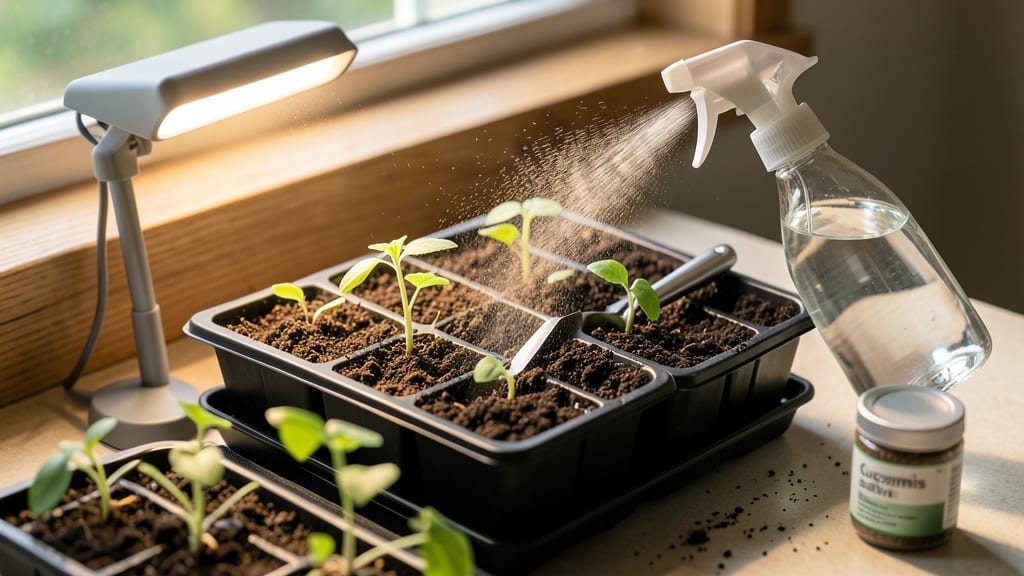
You can start cucumber seeds indoors, but timing and soil conditions are critical to prevent disease and ensure strong seedlings ready for transplant after the last frost. Use a sterile, well-draining potting mix and maintain consistent warmth and humidity.
Starting cucumbers indoors gives you a head start on the growing season, but it requires precision. 🌱 The key is mimicking outdoor conditions as closely as possible—cucumbers thrive in warm soil (70-90°F) and need plenty of light to prevent leggy seedlings.
I recommend using a seed-starting mix with perlite or vermiculite for drainage, and keeping trays under grow lights for 14-16 hours daily. This method works best for varieties like 'Straight Eight' or 'Marketmore' that need a longer growing season in cooler climates.
Once seedlings reach 2-3 inches tall, harden them off by gradually exposing them to outdoor conditions over 5-7 days before transplanting. This reduces shock and helps them adapt to real-world growing conditions. The payoff? A bountiful harvest weeks earlier than if you'd planted directly in the ground!
💡 In This Article
- Optimal Timing and Soil Conditions for Cucumber Seedlings
- Step-by-Step Guide to Indoor Cucumber Seed Starting
Optimal timing and soil conditions for cucumber seedlings
Cucumbers are warm-season plants that need soil temperatures between 70-90°F to germinate properly. Starting seeds indoors typically begins 4-6 weeks before your last expected frost date, depending on your local climate zone.
For example, in Zone 5, this might mean starting seeds in late March, while in Zone 8, you could begin as early as February.
The exact timing varies by cucumber variety—some bush types like 'Bush Champion' mature faster (55-60 days) than vining varieties like 'Straight Eight' (65-75 days), so adjust accordingly. 🌱
The soil mix is critical because cucumber seeds rot quickly in soggy conditions. Use a sterile seed-starting mix combined with 20-30% perlite or vermiculite to improve drainage and prevent damping-off disease—a fungal issue that turns seedlings into limp, brown mush.
I've found that adding a small handful of compost or worm castings to the mix provides just enough nutrients without overwhelming the tender roots. The ideal moisture level should feel like a wrung-out sponge: damp but not waterlogged. Overwatering is the #1 killer of cucumber seedlings indoors.
Temperature control is just as important as moisture. Place seed trays on a heat mat set to 75-85°F to speed germination, which typically occurs in 5-10 days. Once sprouts appear, reduce the heat mat to 65-75°F during the day and 60-65°F at night to prevent leggy growth.
The roots need oxygen too—this is why aeration in the soil mix matters. Without proper airflow, beneficial microbes can't establish themselves, leaving seedlings vulnerable to pathogens. Think of it like giving your plants a healthy gut microbiome!
Light requirements can't be overstated. Cucumber seedlings need 14-16 hours of light daily to prevent them from stretching toward any available light source. Natural sunlight works, but most windows don't provide enough intensity, so supplement with full-spectrum grow lights placed 2-3 inches above the seedlings.
I've seen seedlings grow 6 inches tall in a week if they're light-starved—a sure sign they're desperate for photons. The key is gradual acclimation: start with 12 hours of light and increase by 1 hour every 2-3 days to avoid shock. 💡
One common mistake is using garden soil or potting mix designed for mature plants. These mixes are too dense and can compact over time, suffocating young roots. The ideal indoor mix should feel light and airy, almost like a cloud when you squeeze it.
Add a fungicide like mycorrhizal inoculant to the mix to boost natural disease resistance. This isn't just a fancy add-on—it's like giving your seedlings a superhero cape against fungal invaders that lurk in every seed tray.
Finally, consider the container size. Individual cells or small pots (2-3 inches deep) work best because cucumber roots are fibrous but not deep. Overcrowding leads to competition for nutrients and increases disease risk.
If you're using a shared tray, space seeds 1 inch apart and thin to 2 inches once they have two true leaves. This might seem counterintuitive, but it prevents root binding—a situation where roots circle and strangle each other when transplanting time comes.