
Container Gardens
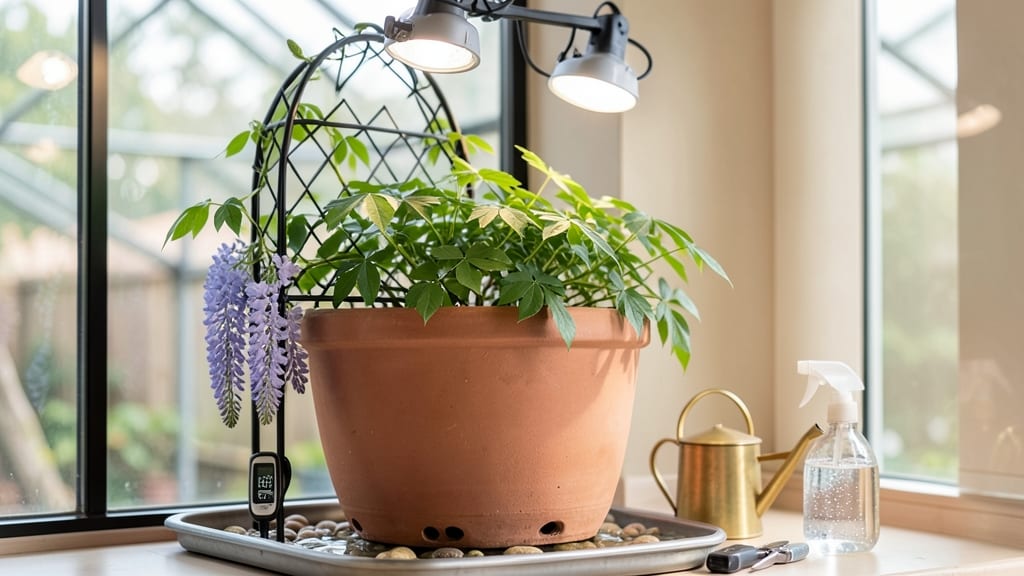
You can grow wisteria indoors, but only with carefully selected dwarf varieties like Wisteria sinensis 'Amethyst Falls' or Wisteria floribunda 'Prolific,' which demand bright indirect light, spacious containers, and a simulated winter dormancy period. Most traditional wisteria species struggle indoors due to their outdoor growth requirements, though attentive care may yield occasional blooms.
Wisteria thrives outdoors with its sprawling vines and abundant blooms, but indoor cultivation requires specific adaptations to mimic its natural environment. 🌿 The biggest hurdle is light—these plants need at least 6 hours of bright, indirect sunlight daily, which is hard to replicate indoors without grow lights.
I've found that placing your wisteria near a south-facing window with sheer curtains helps, but supplementing with a full-spectrum LED grow light for 12-14 hours during winter months makes a dramatic difference in growth and flowering.
Another critical factor is container size. Wisteria roots grow aggressively, so opt for a minimum 15-gallon container with excellent drainage to prevent root rot.
Since these plants need winter dormancy, I recommend moving them to a cooler spot (40-50°F) with reduced watering for 8-10 weeks each year to mimic outdoor conditions. This rest period is essential for encouraging blooms in the following season.
💡 In This Article
- Indoor Wisteria Growth Challenges and Solutions
- Best Indoor Wisteria Varieties and Care Tips
Indoor wisteria growth challenges and solutions
Wisteria's struggle indoors stems from its natural habitat as a vigorous outdoor climber. These plants evolved to thrive in full sun with 6-8 hours of direct sunlight daily, which is nearly impossible to replicate indoors without artificial lighting.
The key challenge is photosynthesis efficiency—indoor light levels are typically 10-20% weaker than outdoor conditions, causing slower growth and fewer blooms. 🌿 Even with bright windows, the light spectrum lacks the full ultraviolet range that triggers flowering in wisteria species.
Humidity control presents another hurdle. Wisteria prefers 40-60% humidity, but indoor air (especially in winter) often drops to 20-30%, leading to brown leaf edges and crispy new growth. I've found that placing a humidifier nearby or grouping plants together creates a microclimate that helps.
For drainage, wisteria roots are prone to rot—so containers must have at least 3 drainage holes and a well-aminated mix of 60% potting soil, 30% perlite, and 10% compost.
The most critical adaptation is simulating seasonal dormancy. Unlike outdoor wisteria that naturally rests in winter, indoor plants need a 8-10 week period at 40-50°F with minimal watering. This mimics the plant's evolutionary need for winter dormancy to store energy for spring blooming.
Without this rest period, you'll likely see stunted growth and no flowers. I recommend moving your wisteria to an unheated garage or basement during winter months.
Pruning presents unique challenges indoors. These plants grow aggressively even in containers, so regular pruning is essential to maintain shape and encourage flowering. The key is to prune right after blooming by cutting back 20-30% of the previous year's growth to stimulate new branches.
However, avoid heavy pruning in the first year—let your plant establish its root system first. Without proper pruning, wisteria can become unmanageable indoors, with vines reaching 10-15 feet in a single season.
Temperature fluctuations also play a crucial role. Wisteria prefers daytime temperatures between 65-75°F and nighttime drops to 55-60°F. Maintaining consistent temperatures helps prevent stress. I've noticed that indoor wisteria often struggle with sudden temperature changes from drafty windows or heating vents, which can lead to leaf drop.
Using a thermometer near your plant helps monitor these conditions.
Finally, nutrient management differs indoors. Wisteria needs regular feeding during active growth (spring to fall) with a balanced 10-10-10 fertilizer every 4-6 weeks. However, reduce fertilization during the winter dormancy period.
Over-fertilizing can lead to excessive leafy growth at the expense of flowers. The key is to match fertilization with the plant's natural growth cycles.