
Plants
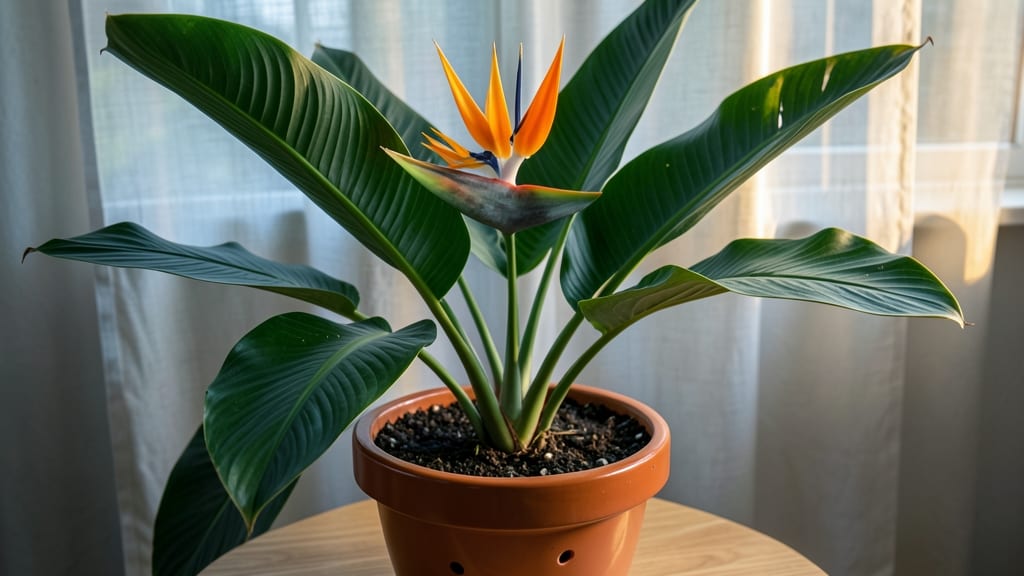
Bird of paradise plants can grow successfully both indoors and outdoors, but outdoor plants grow faster with direct sunlight and higher humidity. Indoors, they tolerate bright indirect light but need consistent moisture and occasional misting to replicate their tropical origins.
This tropical beauty adapts surprisingly well to both settings, though its growth rate and health depend heavily on light exposure and moisture levels. 🌿 Outdoors, they bask in full sun and thrive in warm climates, developing larger leaves and more vibrant blooms.
Indoors, however, they'll still flourish with proper care—just expect slower growth compared to their outdoor counterparts. The key difference lies in humidity: outdoor plants benefit from natural tropical air, while indoor plants often need supplemental misting or a humidifier to prevent brown leaf tips, a common sign of dry air.
Another critical factor is soil drainage. Both indoor and outdoor plants need well-draining soil to prevent root rot, but outdoor plants often get away with slightly heavier mixes thanks to natural rainfall cycles.
Indoors, I recommend using a cactus or succulent mix combined with perlite for optimal airflow around the roots. This makes all the difference when watering schedules become less predictable.
💡 In This Article
- Light and Humidity Needs for Indoor vs Outdoor Bird of Paradise
- Indoor vs Outdoor Care Checklist for Bird of Paradise Plants
Light and humidity needs for indoor vs outdoor bird of paradise
The bird of paradise plant (Strelitzia nicolai) originates from South Africa's subtropical regions, where it receives 6-8 hours of direct sunlight daily and thrives in 60-80% humidity. Outdoors, this translates to rapid growth with leaves reaching 3-6 feet per year under full sun exposure.
The plant's large, glossy leaves develop their signature blue-green hue when basking in 10,000-15,000 lux of sunlight—equivalent to bright midday sun. Without this intensity, outdoor plants may grow leggy or develop smaller leaves.
Indoors, fluorescent or LED grow lights can mimic sunlight but typically provide only 2,000-5,000 lux—about 1/3 of outdoor conditions. This forces the plant to stretch toward light sources, a phenomenon called etiolation.
To compensate, place your indoor bird of paradise within 3-5 feet of a south or west-facing window, where it can receive bright indirect light for 12-14 hours daily.
Rotate the pot weekly to ensure even growth, as leaves will lean toward the light source. 🌿 The plant's flowering process also depends on light quality: outdoor plants often bloom in late winter or spring when daylight hours increase, while indoor plants may never flower without supplemental grow lights.
Humidity is where indoor and outdoor environments diverge most dramatically. Outdoor plants benefit from natural tropical air, with morning dew and afternoon humidity spikes maintaining ideal conditions. Indoors, most homes maintain 30-50% humidity, far below the plant's needs.
This discrepancy often manifests as brown, crispy leaf tips—a classic sign of low humidity. To mimic tropical conditions, mist leaves 2-3 times weekly or use a pebble tray with water beneath the pot.
For severe dryness (common in winter with forced-air heating), a humidifier set to 50-60% humidity near the plant works wonders. The plant's thick, waxy leaves help retain moisture, but they're not impervious to dry air.
Temperature plays a subtle but important supporting role. Outdoors, bird of paradise plants tolerate 50-85°F ranges but prefer 65-75°F for optimal growth. Indoors, most homes naturally fall within this range, but sudden temperature drops (like near drafty windows) can stress the plant.
Cold drafts cause leaf discoloration, while heaters dry out the air—both scenarios require adjustments. For indoor plants, avoid placing them near vents or air conditioning units, which can create microclimates that disrupt their tropical comfort zone. 🌡️
Here's how these factors interact in practice: An outdoor plant in Florida may grow 4 feet in a year with minimal care, while an identical indoor plant in a dry Arizona home might grow only 1 foot annually without supplemental humidity.
The difference isn't just about light intensity—it's about creating a complete environmental replica of the plant's native habitat. Even with perfect lighting, an indoor bird of paradise will struggle without adequate humidity, demonstrating how these two factors work synergistically to support the plant's physiological needs.
The plant's response to these conditions reveals fascinating botanical adaptations. Its large, pleated leaves are designed to maximize surface area for water absorption while minimizing moisture loss—a perfect evolution for its native misty, sunny environment.
This same leaf structure makes indoor plants particularly sensitive to dry air, as the edges become desiccated before the leaf center. Understanding this helps explain why some indoor bird of paradise plants appear healthy but fail to thrive, despite adequate light—often, the humidity deficit is the silent growth limiter. 💧